Daily rituals
An evening reflection routine without a productivity scorecard
An evening reflection is a brief look back at your day, not a review of how much you accomplished. You can use it to record what mattered, acknowledge what felt unfinished, and decide what you want to carry into tomorrow. A few honest sentences are enough; the day does not need a positive conclusion.
Give reflection a clear stopping point
Choose a moment when you are already changing activities: after putting away dinner, finishing your last work task, or plugging in your phone. Set aside about five minutes if that fits your evening. You can also use one minute and a single question. The time limit is a boundary for the exercise, not a target to achieve.
Open a notebook or a blank note and write three headings: Notice, Leave, and Carry. These give the reflection somewhere to go without asking you to reconstruct every hour. If you share your space with others, a short private note is enough. You do not need candles, a quiet room, or a particular mood.
Notice one moment without grading the day
Under Notice, answer: What moment do I want to remember accurately? It might be an enjoyable conversation, an awkward exchange, a task that took more effort than expected, or an ordinary detail you usually overlook. Describe what happened before deciding what it means.
For example: I asked for clarification instead of guessing what the client wanted. That is more specific than I was productive. Another entry might be: I felt disappointed when our plans changed. Both belong here. Reflection can include appreciation and frustration on the same page.
If you want to include gratitude, name a detail rather than searching for a lesson. Someone saved you a seat. A neighbor returned a package. You enjoyed the first few minutes outside. If nothing comes to mind, leave the gratitude question for another day.
Leave an unfinished task somewhere you can find it
Under Leave, write one thing that is still taking up your attention. Then decide whether it needs a next step, a later decision, or simply an acknowledgment. The purpose is to make a note you can return to, not to finish every open task tonight.
A practical entry might read: The appointment is still unbooked. Tomorrow after breakfast, check two available times. For something you cannot resolve yourself, try: I am waiting for a reply; there is no new action to take tonight. If a concern needs a longer conversation, note whom you want to speak with and when you might reach out.
Avoid expanding this section into a complete project plan. Put detailed tasks in your usual calendar or task list. Keep the reflection focused on identifying what remains open and where you will return to it.
Carry one intention into tomorrow
Under Carry, ask: What quality would I like to bring to the next day? Choose a word that fits what you noticed, such as patience, curiosity, honesty, or attention. Turn it into a sentence you can actually use.
If you spent the day rushing conversations, your intention might be: I can let someone finish before I respond. If a project felt too large to begin, try: I can ask one useful question before deciding the whole plan. These are examples to adapt, not instructions for how you should feel.
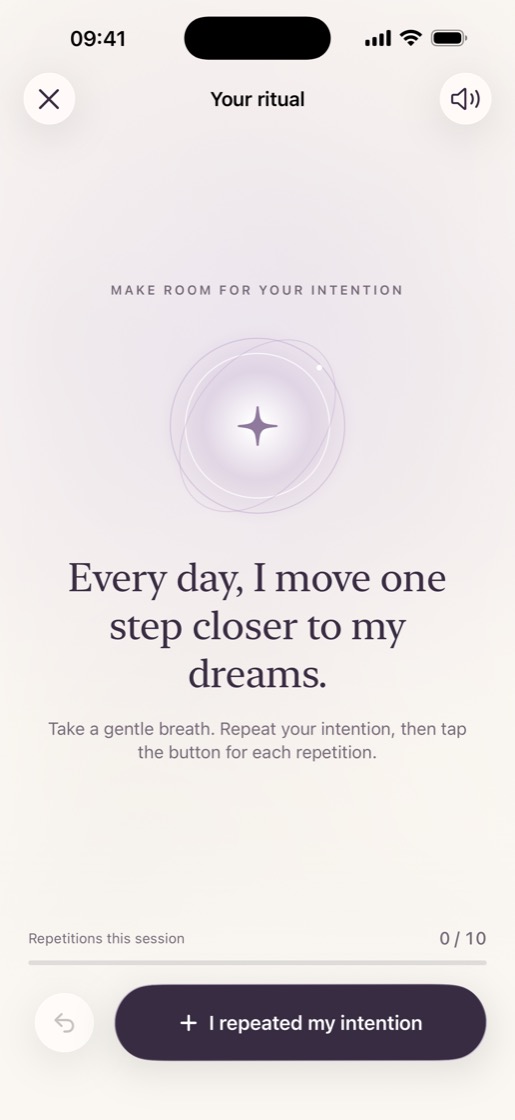
You can keep that sentence with your personal intentions in ManifestMe. If you use a reminder, choose a time when the words will be relevant. An evening reflection and a morning intention can work as a pair: the evening note records what you learned, and the morning note gives you a direction to revisit.
Use a shorter version on complicated evenings
Some evenings do not have room for three headings. Use this sentence instead: Today I noticed ___; tomorrow I want to make room for ___. You can also write only the first half. Choosing a smaller version does not create a debt to make up later.
If looking back turns into repeating the same criticism, stop the exercise. You do not need to extract a lesson from every difficult moment. Put down the note and return another time if you choose. This is a personal writing ritual, not a requirement to process everything before the day ends.
For an example of the full version: Notice: I enjoyed a conversation without checking my phone. Leave: The draft is unfinished; the next step is to outline the last section. Carry: I want to give one thing my attention at a time. The entry is complete because it says what you wanted to record, not because the day itself was complete.
Revisit the notes when they are useful
After a few entries, you can look back for something practical to adjust. Does the same unfinished task keep appearing? It may need a clearer next step, a different deadline, or a decision to set it aside. Do you keep mentioning a particular kind of moment you enjoyed? Consider whether you want to make space for it again.
There is no need to score your entries, maintain a streak, or write a weekly summary. Keep the parts that help you describe your experience honestly. Change the questions when they stop fitting. An evening reflection should leave you with a usable note, not another standard to meet.
Keep your intention close.
Explore personal affirmations, daily rituals, and vision boards in ManifestMe.
Explore the app ↗